

Whither North Korea? The differing fates of the “axis of evil” countries
The current U.S. war with Iran, and questions it has raised about the significance for North Korea, highlights a key difference between the two states’ relations with Washington.
That is, the willingness to negotiate. In this aspect, Tehran and Pyongyang have moved along sharply different paths.
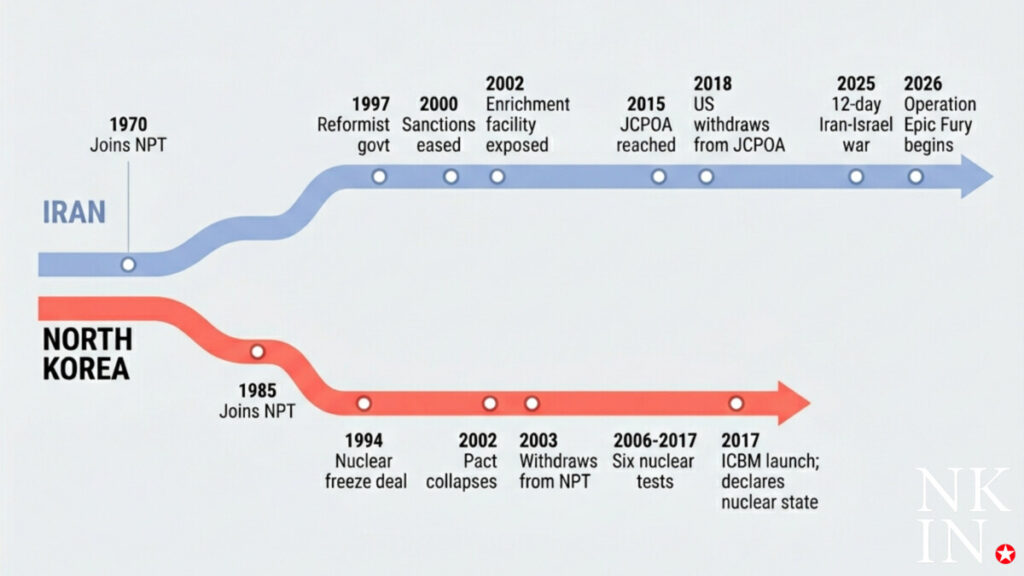
Going back a few years, Iran sought dialogue with the international community. A reformist president, Mohammad Khatami, in 1997 pursued political and social reforms, opened the economy, and sought improved relations with the United States.
That overture was met by an initial limited gesture from Washington. Specifically, in March 2000, then-Secretary of State Madeleine K. Albright announced the easing of some sanctions to allow imports of Iranian carpets, caviar, pistachios and dried fruits.
However, the tentative thaw did not last. After the George W. Bush administration took office, the atmosphere shifted sharply. In 2002, the existence of a covert uranium-enrichment facility at Natanz was publicly revealed by an Iranian opposition group, and led to intensifying pressure for tighter restrictions and sanctions.
Despite these tensions, over time, Iran still chose a negotiated route. This time, it culminated in the Joint Comprehensive Plan of Action, or JCPOA, reached in 2015 with the United States, Britain, France, China, Russia and Germany.
Under the deal, Iran accepted sweeping constraints on its nuclear activities and expanded international oversight in return for sanctions relief. Among the best-known limits were a 3.67 percent cap on uranium enrichment for 15 years and a reduction in installed centrifuges. The agreement also provided for more intrusive inspections, including daily access at Natanz and Fordow for 15 years and application of the I.A.E.A.’s Additional Protocol.
Yet this diplomatic achievement proved fragile. In 2018, the first Trump administration announced that the United States would withdraw from the JCPOA and reimpose sanctions, a move that heightened military tensions in the region.
Subsequently, last June, after Trump was re-elected, the U.S. along with Israel struck Iranian nuclear and military facilities. Now, roughly eight months later, the two countries have launched a large-scale military operation against Iran.
We should compare this history with Iraq. While Iran negotiated over decades, Iraq did nothing to dispel the evidence fears of America and its allies that it was harboring nuclear weapons. If anything, it found the fears convenient. But that posture led two decades ago to an invasion and regime change.
North Korea’s trajectory, meanwhile, diverged from both Iraq’s and Iran’s. In missiles, it has steadily expanded its capability over decades. On the development of nuclear material, it took a very different path from Iran, but avoided the fate of Iraq.
While Pyongyang had agreed to freeze its nuclear program under the Agreed Framework as far back as 1994, relations with Washington deteriorated rapidly after then–U.S. Assistant Secretary of State James Kelly in 2002 raised suspicions about a uranium enrichment program. As a result, the agreement effectively fell apart.
In light of global events, many experts have argued that North Korea’s conviction to hold onto its nuclear program hardened as it watched the U.S.-led invasion of Iraq in March 2003 and the rapid collapse of Saddam Hussein’s government.
One former American diplomatic official said that in foreign-policy circles at the time, it was widely assumed “Pyongyang was watching the invasion closely — and that the episode may have strengthened internal arguments that the country needed a credible deterrent.”
It announced it was withdrawing from the Nuclear Nonproliferation Treaty (NPT), the global pact whereby every country, bar the main nuclear powers, agrees to not develop such weapons. Following this, from 2006 to 2017, Pyongyang conducted six nuclear tests, thereby signaling to the world that it was accelerating its weapons program. This was despite successive rounds of attempted diplomacy and international sanctions.
Eventually, after testing the Hwasong-15 intercontinental ballistic missile (ICBM) in November 2017, the Kim Jong-un regime declared that it had finally completed its state nuclear force.
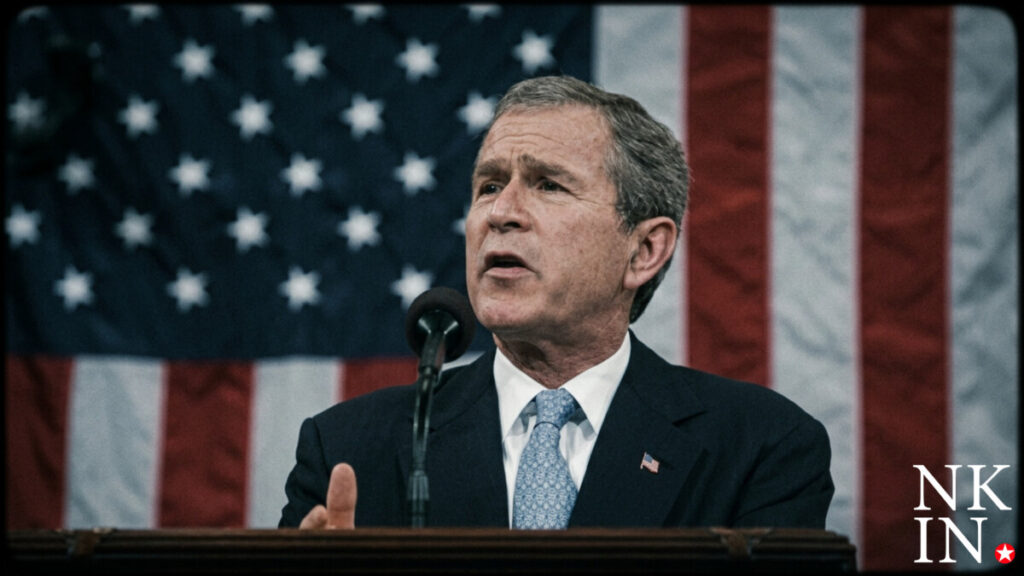
Looking back, history sometimes leads to endings few could have envisioned. In 2002, Bush grouped Iraq, Iran and North Korea together as an “axis of evil.” Yet, twenty-four years later, the three have faced sharply different outcomes. Iraq was invaded. Iran pursued negotiations and still came under attack.
Consequently, what now worries many in the region is what Iran’s situation in 2026 may signal to North Korea — and whether it will reinforce Pyongyang’s conviction that it should build even more.
For South Korea, in particular, the security threat continues to grow. North Korea has made clear it has no intention of giving up its nuclear arsenal. Moreover, over the past two decades, cycles of diplomacy and sanctions have done little to halt Pyongyang’s progress.
In this context, the remaining question is whether the international community continues to treat denuclearization as an attainable goal — or whether it moves toward a new framework for managing a nuclear-armed North Korea.
It is the question posed by the only country still standing from the “axis of evil.” The answer, for now, remains unresolved.

Yoonseo Im is a Seoul-based trilingual journalist and researcher. Growing up in three different countries has shaped her international perspective on the Korean Peninsula. She is a Ph.D. candidate in International Studies and holds prior degrees in Political Science and International Relations. She is also active in multiple research organizations focused on regional issues, including North Korean affairs. Her work explores the intersection of economics, industry, politics, and security in Korea and the broader region, combining academic expertise with reporting experience gained through field journalism. Contact: [email protected]
Latest posts by Yoonseo Im (see all)
- North Korea isn’t building the next ChatGPT. It’s building something else. - June 14, 2026
- May Day and the unheard cry beneath the propaganda - May 13, 2026
- North Korea’s new cybercriminals - April 15, 2026