

Regime showcases new nuclear-capable rocket launchers ahead of Party Congress
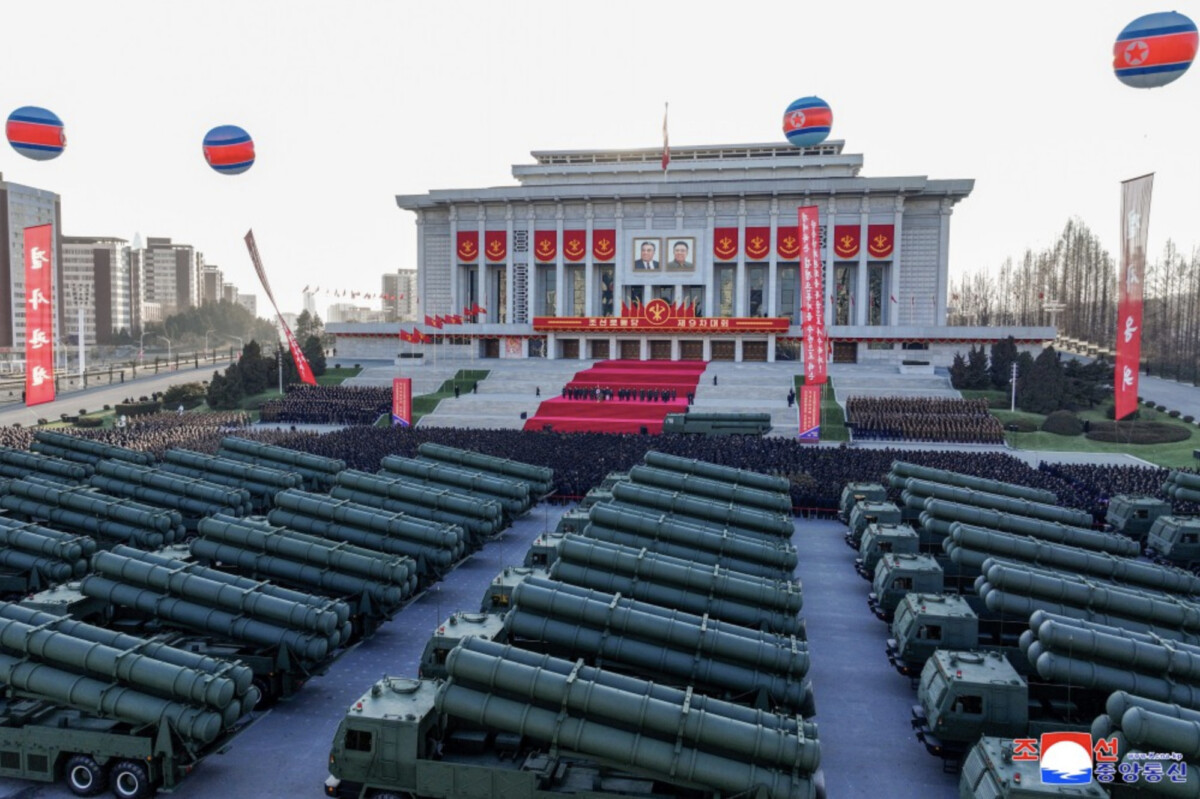
North Korea showcased 600mm multiple rocket launchers this month (Image: KCNA)
North Korea showcased 50 nuclear-capable rocket launchers at a ceremony on February 18 ahead of the all-important Ninth Congress of the ruling Workers’ Party of Korea.
The sight of rows of super-large multiple rocket launchers lined up in front of the April 25th House of Culture in Pyongyang, the venue for the Congress, demonstrated that the event was not merely a weapons handover, but a political demonstration of the regime’s defense industry achievements and a display of deterrence to the outside world.
The new rocket launcher is “the world’s most powerful concentrated super-strong assault weapon, perfectly combining the precision and destructive power of tactical ballistic missiles with the rapid-fire capability of rocket artillery,” Kim said in a speech at the ceremony. “The enemy’s military infrastructure and command system will collapse instantly.”
The rocket launcher is referred to by experts as the KN-25. It has an estimated range of 380–400 km, which puts all of South Korea within striking distance, including command centers, air bases, missile defense systems, and major critical infrastructure.
With a diameter of 600mm, warhead weight of 300–500 kg, and a circular error probable (CEP) of 80–90 meters, the KN-25 is considered closer to a short-range ballistic missile (SRBM) than a conventional rocket artillery system. Its multiple-launch capability allows for rapid mass warhead delivery, raising concerns that it could neutralize South Korea’s “Kill Chain” strategy of detecting and preemptively striking North Korean launch sites.
North Korea claimed to have produced 50 units in just two months, a figure confirmed by foreign media analysis. Military outlets abroad noted that deploying more than 50 KN-25 launch vehicles ahead of the 9th Party Congress signals a doctrinal shift toward integrated nuclear and conventional operations.
The regime also asserted that the weapon is equipped with AI-based guidance and electronic warfare countermeasures. While some foreign reports highlighted mention of “AI-based anti-jamming functions” as an attempt to flaunt technological superiority, experts largely view these claims as propaganda.
Analysts in South Korea and the U.S. acknowledge the KN-25’s improved precision and long-range strike capability compared to older rocket artillery, but question whether North Korea has truly implemented advanced AI or complex guidance systems.
The greatest concern among experts is the KN-25’s potential role as a tactical nuclear delivery platform. North Korea unveiled its “Hwasan-31” tactical nuclear warhead in 2023, and the KN-25’s payload capacity and design are assessed as compatible with it. Foreign media noted Kim’s remark that the weapon is “suitable for special attacks and strategic missions,” interpreting it as a clear hint at nuclear delivery capability.
The mass deployment of these rocket launchers is thus seen not only as a demonstration of weapons performance but also as a strategic message aimed at South Korea, the U.S., and Japan.
The KN-25’s short launch preparation time and use of mobile transporter-erector-launchers (TELs) make detection and interception difficult. South Korea’s Patriot, L-SAM, and THAAD systems are optimized for ballistic missile interception, but weapons like the KN-25—occupying the “gray zone” between rocket artillery and missiles—are harder to counter.
Experts warn that North Korea’s large-scale deployment of KN-25s enhances its ability to overwhelm South Korea’s missile defense through saturation attacks. If more than 50 launchers were fired simultaneously, South Korea’s interception systems could be physically incapable of responding.
Ultimately, the presentation ceremony served as a stage for North Korea to flaunt its defense industry achievements and exaggerate its deterrence against South Korea and the U.S.
Kim’s remarks emphasized technical capabilities but fundamentally aimed to undermine South Korea’s response strategies, showcase nuclear and missile strength, and bolster bargaining power. Domestically, the event also sought to encourage loyalty competition within the defense industry and strengthen regime unity ahead of the Party Congress.

Taesung offers informed perspectives on North Korean society, grounded in years of experience within a key state-run institution. After defecting to South Korea in 2024, he now focuses on providing analysis of the country.
Latest posts by Kim Taesung (see all)
- Kim says new main battle tank capable of “neutralizing almost all” existing anti‑tank weapons - April 7, 2026
- Seoul reverses course, joins U.N. resolution on North Korean human rights - March 30, 2026
- Carbon‑fiber solid‑fuel engine test marks new phase in North Korea’s ICBM advancement - March 30, 2026