

For children, learning loyalty to the leader is more important than classes
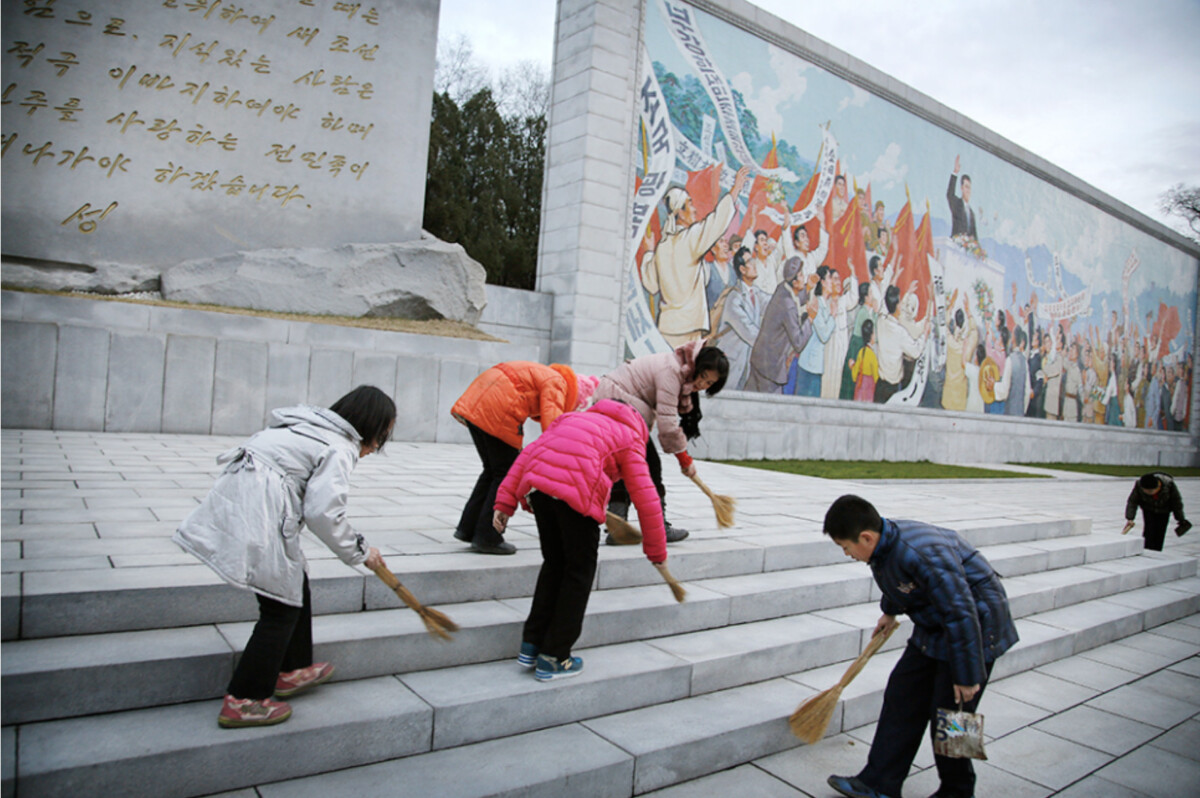
Children cleaning in front of Kim Il-sung’s mural in Pyongyang | photo source: Yonhap News
Children born in North Korea grow up with the word “loyalty” from their earliest years. This word does not refer simply to moral education or the cultivation of patriotism. It represents a systemic mechanism that enforces absolute loyalty and worship toward the Kim family that has ruled the country from Kim Il-sung at the beginning, through Kim Jong-il, and now to Kim Jong-un. Growing up in North Korea, I experienced this process firsthand and felt deeply how “loyalty” involved the suppression of individual freedom and independent thought.
In nearly every region of North Korea, statues, monuments, or portraits of Kim Il-sung and Kim Jong-il dominate public spaces. Even before entering elementary school, children are taken by their kindergarten teachers and taught to bow before these statues and offer flowers. This is not a mere ritual but a compulsory duty known as “loyalty work.”
Upon entering elementary school, the first lesson a child learns is “love for the Leader and the General.” Textbooks are filled with legendary tales of Kim Il-sung and Kim Jong-il from their childhoods. Kids have to memorize them. Then, they get examined on them.
When I was young, questions like, “How should we respect the Leader?” were considered more important than solving math problems. Teachers constantly repeated, “We live thanks to the grace of our Beloved Marshal.” We accepted this without even the shadow of doubt. Loyalty was valued above knowledge.
Each school day began with loyalty work. Students treated it as part of daily life. In every village, the statues and monuments depicting the Kims were, and still are, maintained by caretakers who would sweep and polish them each morning. After the caretaker finished, students arrived early with brooms and wet cloths, cleaning again and again. Sometimes several groups of students polished the same statue in a single morning. This was not a matter of maintenance, but loyalty in action.
If dust was spotted on a statue, it was interpreted as evidence of a lack of loyalty among the local residents and students. Children competed to clean and offer flowers on occasions like public holidays and the birthdays of the Kim family members. This created a financial burden, since the cost of flowers had to be borne by local people themselves.
Children in North Korea learn loyalty even through play and songs. In kindergarten, they sing songs praising Kim Il-sung and Kim Jong-il. They grow up learning how to express “love for the Kim family.” I remember playing “leader games” with friends. One of my friends would play Kim Il-sung, while the others acted as loyal followers.
Such education works to suppress personal freedom. North Koreans who fail to express loyalty to the Kim family risk social ostracism or even punishment as political offenders. People show devotion not out of sincerity but out of fear.
I often harbored doubts, but outwardly I had to display loyalty. Otherwise, I would face disadvantages at school or problems at work. Loyalty was not a choice. It was a condition for survival.
When we outside of the country discuss North Korea’s human rights issues, we should not only pay attention to political prison camps and food shortages. We also need to focus on this thought control. It is a weaponized assault on human dignity, forging chains of the mind that are harder to break free from than prison walls or hunger.

Kim Yumi, a North Korean defector, was born and raised in Haeju, South Hwanghae Province, a coastal military area. Growing up near a naval base, she was able to secretly watch South Korean news programs and TV shows, thereby uncovering the vibrant, democratic society of South Korea. Yumi and her husband made the brave decision to escape North Korea and seek a better future. Now in Seoul, she is actively involved in raising awareness about the realities of life in North Korea, especially on her YouTube channel, “@KimYumiTV.”
Latest posts by Kim Yumi (see all)
- Can ordinary joy awaken the people of North Korea? - February 19, 2026
- Remembering the Yeonpyeong Island bombardment - February 13, 2026
- The people at the front are the poorest: The life of a Party member - February 9, 2026