

2026 calendars reveal regime priorities: Nuclear weapons, hereditary rule, and tourism
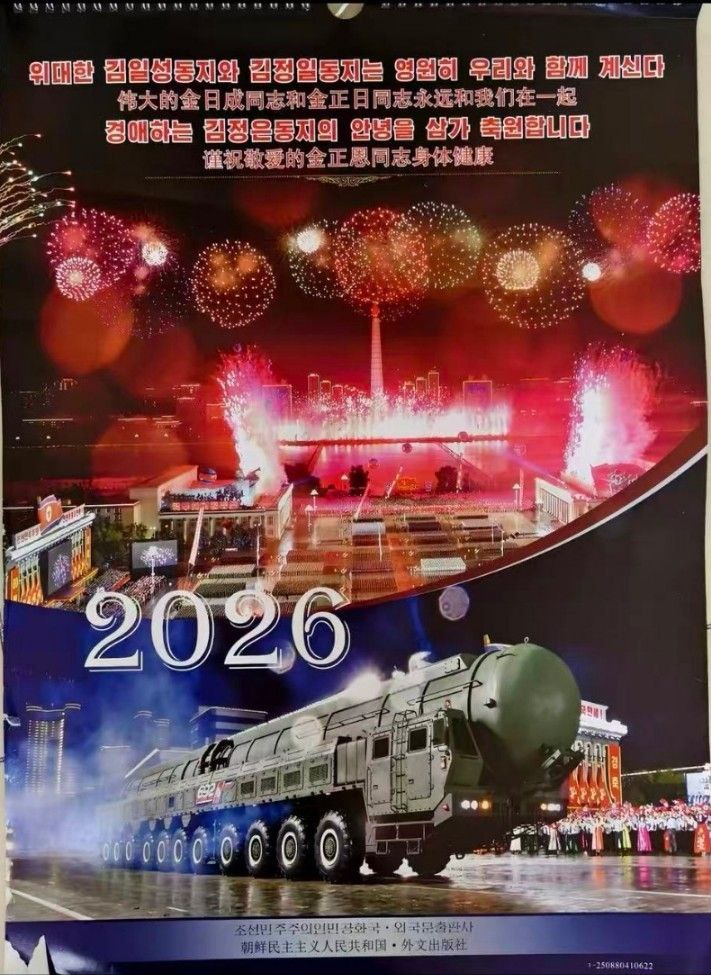
2026 calendar | Image: NK Insider
North Korea has unveiled its 2026 New Year calendars and, true to form, they feature beautiful scenery and missiles.
That is because, in the isolated, militarized state, a calendar is no mere household item or gift for friends. It is a state propaganda tool that signals the intentions of the Party and its leader, serving to emphasize regime preservation and the legitimacy of hereditary succession.
The 2026 calendars feature the new intercontinental ballistic missile, scenic views of Mount Paektu, and the Wonsan–Kalma International Coastal Tourist Area.
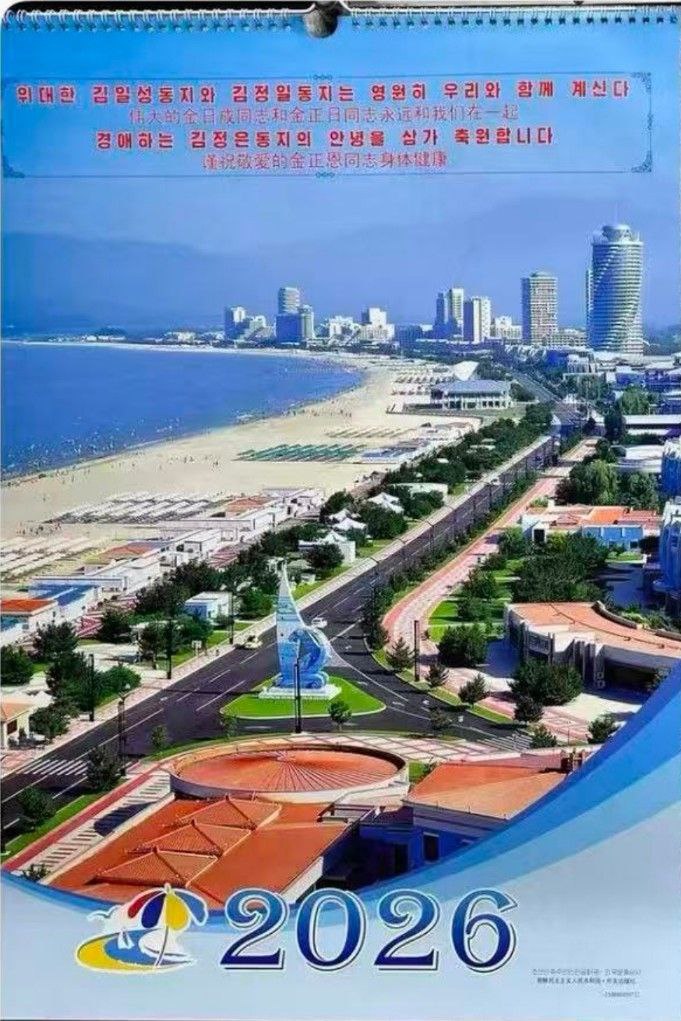

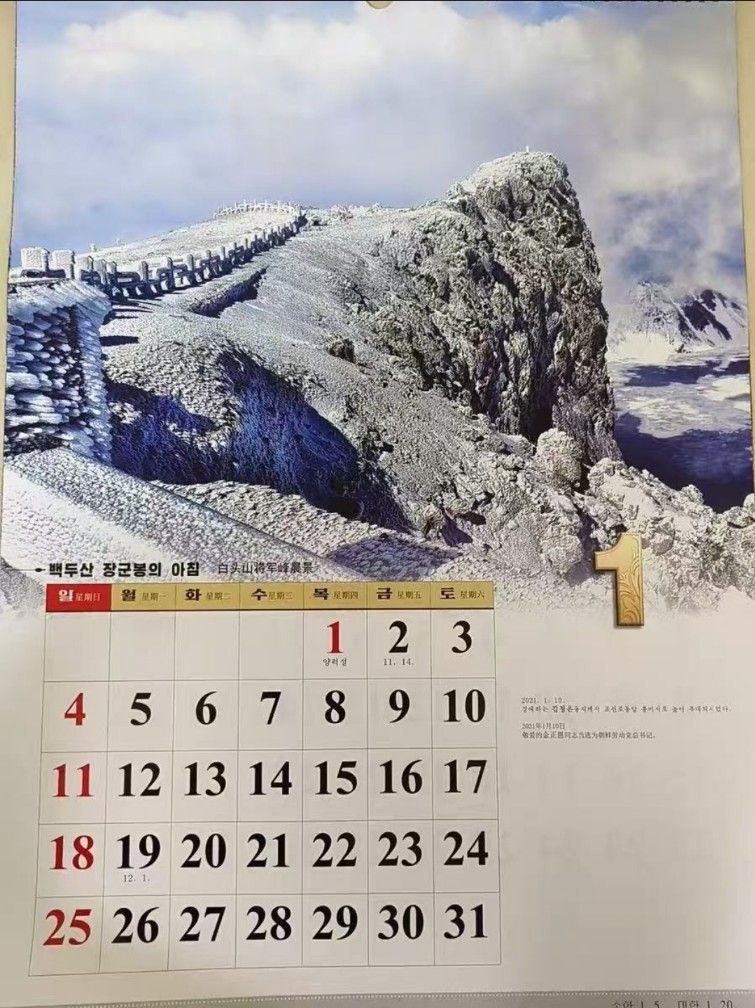
Next year’s calendars published by North Korea’s Foreign Languages Publishing House | Image: NK Insider
Issued by the Foreign Languages Publishing House, all calendars undergo strict censorship and approval by the Workers’ Party. As a result, even if multiple presses produce them, the overall direction remains the same.
The new calendars indicate that Kim Jong-un’s priorities for 2026 are strengthening military power and nuclear weapons, reinforcing the legitimacy of the three-generation succession, and earning foreign currency through international tourism.
One calendar highlights the new intercontinental ballistic missile, the Hwasong-20, which was showcased during the October 10 parade marking the founding of the Workers’ Party. This sends a symbolic message that the regime will continue prioritizing military buildup in 2026.
Nuclear weapons development has become Kim Jong-un’s core means of securing regime survival amid confrontation with the international community.
The calendar flaunts the potential of new ballistic missiles, armored vehicles, and other modern military equipment. However, this aggressive posture may also expose the regime’s instability to both North Korean citizens and the outside world.
Another calendar features Mount Paektu on its cover. This of course is not just the highest peak on the peninsula. It is the sacred mountain where Kim Il-sung’s revolutionary tradition began. Citizens are constantly urged to emulate the “Paektu revolutionary spirit.” The reason for this emphasis is that it serves to justify the three-generation succession from Kim Il-sung to Kim Jong-il to Kim Jong-un, while instilling loyalty among the population.
A third calendar showcases the newly developed Wonsan–Kalma International Coastal Tourist Area, located in Wonsan, which has been declared as Kim Jong-un’s hometown.
This reflects the regime’s strategy to attract foreign tourists and secure hard currency. Tourism is being used as a means of funding the regime and sustaining the system.
One interesting point to observe is that the 2026 calendars continue the trend set in 2025 of not specifying the Juche year. This refers to the system which sets Kim Il-sung’s birth in 1912 as Year One.
However, unlike in 2024 when authorities ordered the omission of “Day of the Sun” (Kim Il-sung’s birthday, April 15) and “Day of the Shining Star” (Kim Jong-il’s birthday, February 16), this year’s calendar includes those names.
Although Kim Jong-un’s birthday (January 8) is known, it has not yet been officially marked in the calendar. Some observers note that while textbooks detail the birth and childhood of Kim Il-sung and Kim Jong-il, they omit Kim Jong-un’s birth and family background, fueling speculation and rumors.
The calendars are published by various presses. Production is closely tied to financial quotas assigned to each publisher, and failing to sell calendars during this period leaves them with little opportunity to raise funds.
Most calendars are sold on the market at prices ten times higher than the state-set rate. Officially distributed calendars are sold to enterprises of varying ranks (special-class, first-class, second-class, third-class). They are primarily supplied to managers, Party secretaries, and other unit leaders, and displayed in their offices. In some cases, officials siphon off extra calendars to resell them illegally.
Ordinary citizens must buy calendars at markets, where the price is equivalent to about 10 kilograms of rice. For people living hand-to-mouth, calendars are little more than a “pie in the sky.”
Ultimately, only high-ranking cadres and the wealthy can obtain them, starkly revealing the gap between regime propaganda and the daily lives of ordinary citizens.

Era is a North Korean defector and an experienced journalist who offers a unique perspective on one of the world's most secretive nations. Having escaped the oppressive regime, Era has leveraged her keen understanding of North Korean society to become a beacon of truth. Through her extensive network of in-country reporters, she maintains real-time communication with sources inside North Korea, providing unparalleled insights into the ground realities of the closed society.
Latest posts by Era Seo (see all)
- New propaganda material aims to enforce loyalty amid declining faith in leadership - February 6, 2026
- Anti-socialist and non-socialist struggle video reveals changing lifestyles (Part 1) - February 1, 2026
- Propaganda refers to the country as “Kim Jong-un’s Korea”… Growing possibility of public backlash - January 10, 2026