

Remembering the Yeonpyeong Island bombardment
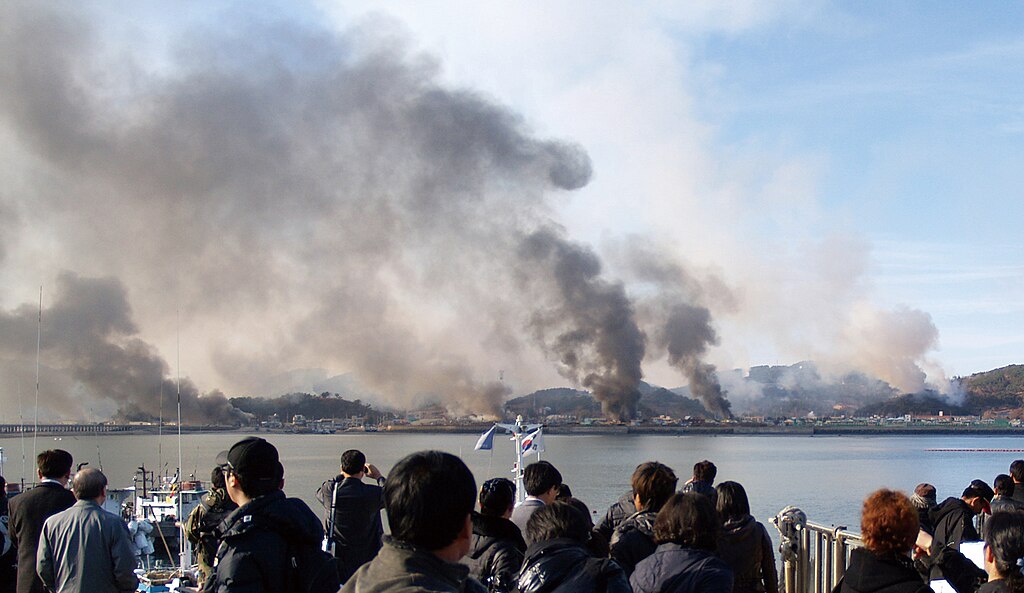
Image: ROK Armed Forces
At 2.30 p.m. on November 23, 2010, the peace on the small, quiet, South Korean island of Yeonpyeong in the West Sea, was shattered in an instant.
North Korean artillery shells and rockets fell from the sky that afternoon bringing with them the terror of war itself.
The shells, fired from the North Korean mainland, just 12 kilometers from the island, did not target only military facilities. They struck indiscriminately, smashing into homes, villages, and spaces where people lived. Two marines and two civilians were killed, and 19 were injured. Houses and facilities were engulfed in flames and were reduced to ruins.
This was the first case since the Korean War armistice of 1953 in which North Korea directly attacked South Korean territory, causing civilian deaths. The incident was not merely a localized clash but a symbolic event that revealed the North’s military mindset and pattern of provocation.
Pyongyang justified its attack by claiming that South Korean maritime drills being held in the area constituted a violation of its territorial waters. But interpreting the bombardment of Yeonpyeong as a simple response to a military exercise is an oversimplification.
The North’s provocations have always combined external messages with internal propaganda. To its people, it sought to instill the image of fearlessness and resolve. The message was “we are strong” and “we are taking on the enemy.” To South Korea, it aimed to sow psychological fear. To the international community, it was a calculated move to assert itself as a country that was not to be underestimated.
The terror of that day was not confined to islanders. I remember it well because I was living in North Korea at the time and my own village was not far from Yeonpyeong. Just 13 minutes after the attack, South Korea responded by firing 80 K-9 self-propelled artillery shells against Mudo Island, where the North Korean artillery unit was located. When South Korean shells landed near our area, only one thought crossed my mind: “Ah, this really is war now.”
We were gripped by fear, though in a different way from southerners. We did not know where to flee to and we did not know what was true. The authorities did not explain the situation properly, repeating only that their action was a “righteous response to enemy provocation.” People listened to slogans blaring from radios and loudspeakers, staring anxiously at one another.
I cannot forget the sight of North Korean soldiers at the time. They were nothing like the “steel-like People’s Army” depicted in propaganda. They were exhausted from hunger and cold, their bodies thin and frail. It took five struggling men to carry a single shell. The gap between the rhetoric of a “military powerhouse” and the harsh reality was immense.
Officially, the North claimed the damage received on our side was minimal, but residents experienced a different reality. A neighbor was struck down by shell fragments, and a cow in the yard was killed instantly. There was blood and screaming. But this was not a movie. It was real and unfolding before my eyes. In that moment, I felt just how cruel the word “war” truly is.
War is not only the business of soldiers. It destroys ordinary lives first. Children’s cries, adults’ fear, livelihoods and routines collapsing overnight. War always breaks the weakest first.
The international community reacted immediately after the Yeonpyeong bombardment. The United States, Japan, and the United Nations strongly condemned North Korea, while South Korean society was gripped by tension over the possibility of full-scale war. South Korea greatly strengthened its West Sea defense system and heightened military readiness.
The bombardment was not an isolated incident but a turning point that escalated military tensions on the Korean Peninsula.
North Korea’s provocations did not stop there. From past naval skirmishes in the West Sea, to the sinking of the Cheonan earlier in 2010 with the loss of 46 South Korean sailors, to repeated missile tests in the years that followed, North Korea has engaged in recurring clashes and shows of force.
The common thread is clear: threats outward, unity inward. Military actions are used as tools for regime survival and control. The lessons of the Yeonpyeong bombardment are unmistakable. First, military provocations can be repeated at any time in new forms. Second, civilians are always the first to suffer. Third, peace cannot be preserved by declarations alone. It requires thorough preparedness and a perspective that places human lives at the center.
The Yeonpyeong bombardment is not merely a past event. It continues to serve as a warning today, reminding us that peace is precious, but also fragile. And under the name of military strategy, countless ordinary lives can be sacrificed.
The Korean Peninsula remains tense today. North Korea flaunts its presence through missile tests and military drills, while South Korea strengthens its defenses in response. Yet at the heart of all these discussions must always be people. The most important message Yeonpyeong left us is this: to prevent such tragedies from repeating, safeguarding peace must go beyond military calculations—it must mean protecting human lives.

Kim Yumi, a North Korean defector, was born and raised in Haeju, South Hwanghae Province, a coastal military area. Growing up near a naval base, she was able to secretly watch South Korean news programs and TV shows, thereby uncovering the vibrant, democratic society of South Korea. Yumi and her husband made the brave decision to escape North Korea and seek a better future. Now in Seoul, she is actively involved in raising awareness about the realities of life in North Korea, especially on her YouTube channel, “@KimYumiTV.”
Latest posts by Kim Yumi (see all)
- Rising oil prices send ordinary North Koreans into survival mode - March 30, 2026
- Is Kim Ju-ae being groomed for a support role? - March 17, 2026
- Kim Jong-un’s emphasis on women is core part of regime survival strategy - March 9, 2026