

North Korea and its money-making overseas workers
With turmoil spread across the Middle East in recent weeks, international attention is drawn once again to the familiar specter of North Korea.
The connection between Pyongyang and the region is often framed through the lens of weapons and security concerns. Yet the relationship runs deeper.
Weapons alone do not explain the links. For years, North Korea has quietly built a presence in the region through a less visible path of labor, often in ways that attract little public attention.
At construction sites and infrastructure projects across the Gulf, North Korean workers have been present for years, sometimes decades.
To understand how this system works, one must look at how North Korea has long relied on its workers overseas.
The practice dates back to the 1960s, when Pyongyang began sending logging crews to the Soviet Union. Over time, the system expanded. Today, tens of thousands of North Korean laborers are believed to be overseas.
They represent one of the regime’s oldest and most consistent strategies for acquiring foreign currency, besides illicit trade and front companies, in the face of international sanctions.
Exporting labor has been a relatively stable means of earning dollars, as the regime continues to invest heavily in nuclear and missile development.
Current estimates suggest that roughly 80,000 workers are deployed in some 16 countries. Their working conditions have frequently drawn criticism from human rights organizations.
Most of their income is believed to be confiscated and redirected to state accounts. Those funds are widely believed to support party operations, government spending, and military production, thereby helping sustain the rule of North Korean leader Kim Jong-un.
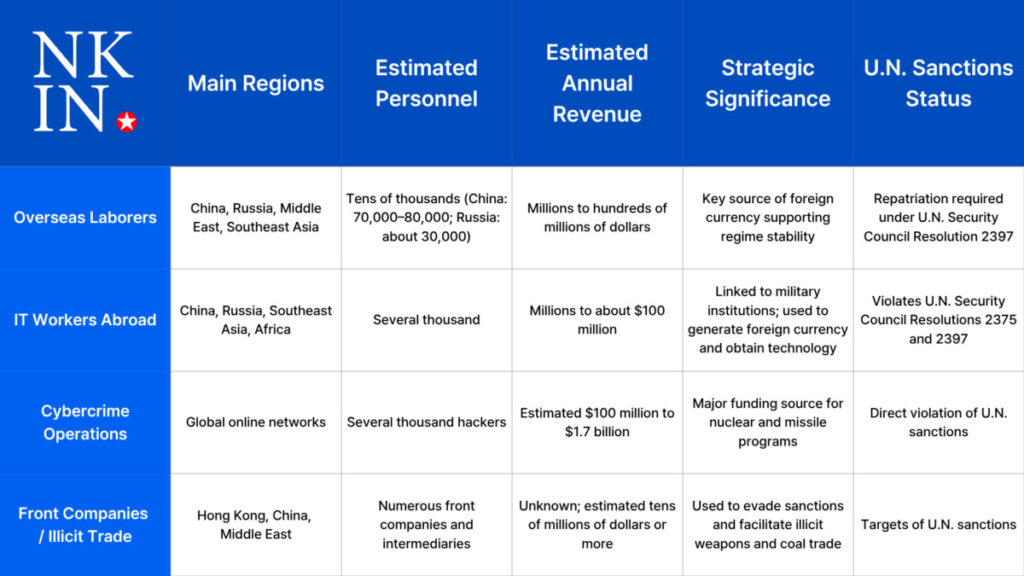
A 2025 report by the Korean Peninsula Issues Research Institute estimated that tens of thousands of North Korean workers were in China, Russia, the Middle East and Southeast Asia. Their annual earnings are believed to generate tens of millions to hundreds of millions of dollars.
Before UN restrictions tightened in recent years, the scale may have been even larger.
In a 2025 report, the Refugee Studies Centre at the University of Oxford suggested that the number deployed abroad could once have reached as many as 420,000. The estimate was based on projections from in-depth interviews.
Even if that number represents a high-end estimate, researchers broadly agree that the system has been both extensive and durable.
According to the Oxford report, North Korean workers in Qatar were employed through a construction firm known as Arab International Construction Union Company in Doha, where they worked on hotel developments and government buildings.
In the United Arab Emirates, labor units linked to the military were reportedly deployed, while Kuwait maintained a relatively high number of North Koreans despite limited diplomatic relations with Pyongyang.
For decades, North Korea’s foreign currency earnings have followed a surprisingly simple path.
The locations may appear far apart on a map. Economically, however, they pointed in the same direction: Pyongyang.
The system has proved remarkably durable. Even as sanctions tightened and diplomatic relationships shifted, North Korea’s overseas labor networks never fully disappeared.
While global attention often focused on missiles and military alliances, labor exports remained one of the regime’s most practical survival strategies.
Which raises a question.
If a country that has long relied on sending workers abroad to earn foreign currency can no longer do so as easily as it used to, what are they working on now?
The answer may lie far from construction sites and labor camps and in a new generation of revenue streams emerging beyond the reach of traditional sanctions.

Yoonseo Im is a Seoul-based trilingual journalist and researcher. Growing up in three different countries has shaped her international perspective on the Korean Peninsula. She is a Ph.D. candidate in International Studies and holds prior degrees in Political Science and International Relations. She is also active in multiple research organizations focused on regional issues, including North Korean affairs. Her work explores the intersection of economics, industry, politics, and security in Korea and the broader region, combining academic expertise with reporting experience gained through field journalism. Contact: yxn.contact@gmail.com
Latest posts by Yoonseo Im (see all)
- North Korea and its money-making overseas workers - April 9, 2026
- Whither North Korea? The differing fates of the “axis of evil” countries - March 14, 2026
- What does the attack on Iran mean for North Korea? - March 10, 2026