

Is South Korea starting to give up on re-unification?
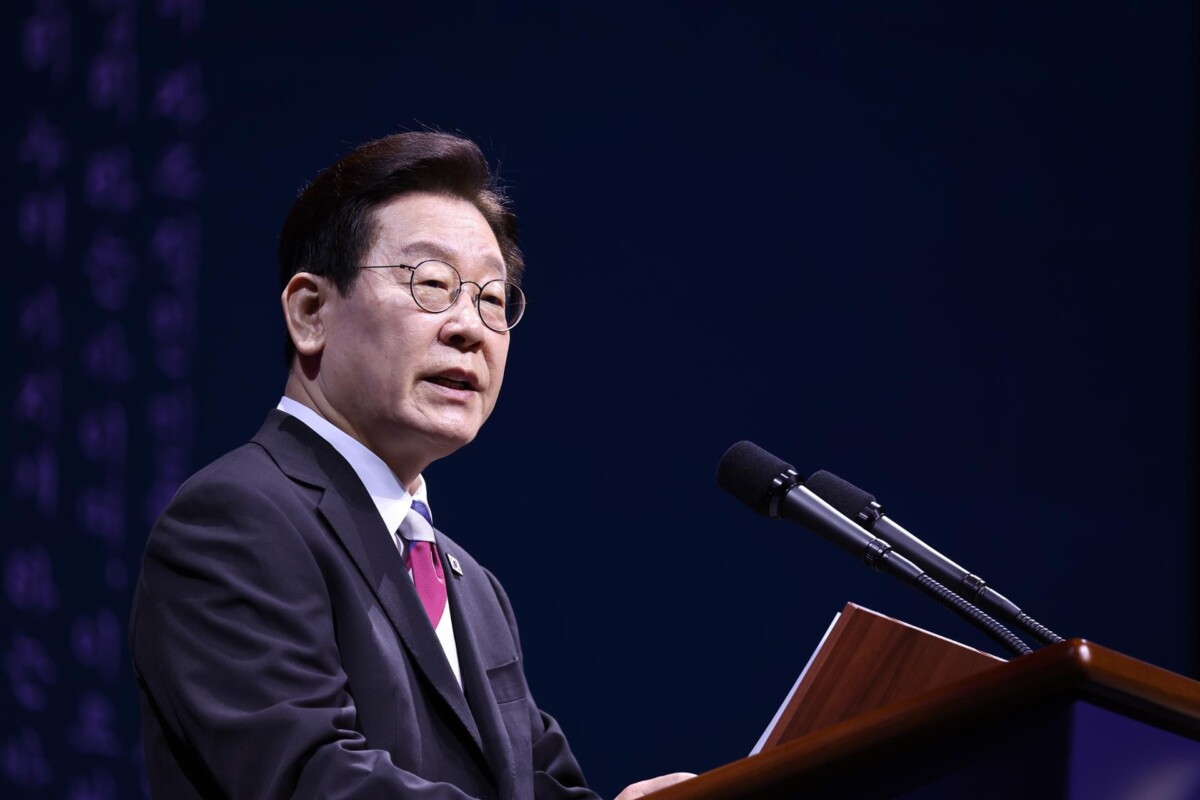
President Lee Jae Myung delivers a commemorative address at the 107th March First Independence Movement ceremony at COEX in Seoul. (Image: Joint Press Corps)
When North Korean leader Kim Jong-un announced in late 2023 that re-unification was no longer going to happen, the reaction in South Korea was as if, as the old proverb goes, the dogs had barked and the caravan had moved on.
In other words, we all paused for a second, then carried on doing what we were doing as if nothing had happened. That meant nothing made us question the commitment to our own sacred national goal of eventual re-unification with our wayward brother in the North.
Even when Kim added that his rejection of unification meant South Koreans were now foreigners and enemies, and even when he changed the northern constitution and school textbooks, we shrugged it off.
Those in the South who did ponder it asked, was this a tactical shift? Would Kim change his mind? Would things change with a new leader? There were no answers and little discussion. And so, the official stance in Seoul remained unchanged. We still want unification.
Now, two years later, North Korea is still anti-unification. Just last month, at the Ninth Party Congress of the ruling Workers’ Party of Korea, Kim drew “a historical line” under the “abnormal relationship” that has existed between the two Koreas since the end of war in 1953. The North-South relationship is now as one between “the most hostile of states,” he said.
Now we know he is still serious, how should we respond? Should we, too, give up on unification, at least as a formal commitment?
For decades, for South Koreans, even raising the unification question in this way has been politically sensitive. The concept occupies a near-sacred place in the national narrative.
Suggesting that Seoul might reconsider is seen not just as defeatist but as evidence of treason.
That sensitivity has not been entirely unreasonable. The earliest voices arguing for abandoning or downplaying reunification often came from ideological corners where skepticism about the goal was intertwined with sympathy for Pyongyang or hostility toward the U.S.–South Korea alliance. That made pragmatic discussion of the issue difficult.
The South Korean constitution requires the government, whether it is left or right, to be pro-unification. What distinguishes one government from another is what they actually do about it. Some people aren’t interested in unification or may even not want it, but no political party takes an anti-unification position.
But appearances can be deceptive. There is a deep current running under this dilemma. It is that we in South Korea are a democratic people. Our values prevent us from forcing ourselves on an unwilling partner. North Korea would have to want us before we can unify.
With that in mind, we should anticipate, if not a loud policy change, then perhaps a quiet shift. South Korea has actually done this before.
In the early 1990s, the dramatic unification of Germany initially stirred excitement in Seoul. If East and West Germany could reunite so quickly after decades of division, perhaps the same could happen here, people thought. But as the enormous economic and social costs of German unification became clear — the massive fiscal transfers, the economic disruptions, legal disputes by westerners trying to reclaim their land in the east, and the long-term integration challenges — policymakers and analysts in South Korea began reassessing their own assumptions.
Government analysts realized that South Korea would not be able to manage a collapsed North. The shock happened very quickly – within a year of the German unification. But nothing was said publicly.
What happened was that the earlier idea that the South might eventually absorb the North gave way to a more cautious concept: step-by-step unification. We learned a new word: “gradualism.” Instead of imagining a sudden takeover scenario, Seoul began emphasizing long-term coexistence, economic engagement, and incremental integration. The goal of reunification remained, but the presumed path toward it changed.
In a way, this was an anti-unification policy, but it was presented as a more sensible way to do it. This was understood by politicians on all sides and by the public. Thus, the long-term commitment to unification remained but the whole approach was changed in the direction of delay.
I believe that something similar is happening again. This time it is in response not to developments abroad but to a blunt declaration from Pyongyang itself. The strategic environment is changing quickly, and the tone of policy debate appears to be evolving.
A small but telling signal appeared in the speech delivered by President Lee Jae-myung marking the anniversary of the March 1st Movement, the 1919 uprising against Japanese colonial rule. Traditionally, presidential speeches on that day strongly emphasize the eventual reunification of the Korean nation.
Lee’s address took a somewhat different approach. The language of peace and coexistence was prominent; the language of reunification was noticeably less so.
The president spoke of realizing “the dream of peace and coexistence that our forebears earnestly yearned for.” He called for reducing military tensions, restoring trust and reopening dialogue across the peninsula. The emphasis was not on historical destiny but on stability and coexistence.
Unification appeared only briefly — and in negative form. Lee pledged that Seoul would not pursue “unification by absorption” in any shape or form. This phrase was long used in the North to describe its fears of being swallowed by the South.
There is a pragmatic logic behind this rhetorical shift. A government seeking to reopen communication channels with Pyongyang must recognize that constant references to unification sound threatening from the North’s perspective. Despite this dropping by Seoul of “unification by absorption” decades ago, the North still fears it is the real underlying intention.
Lee therefore emphasized respect for the North’s system and criticized provocative actions by activists in the South, including drone launches carrying propaganda across the border. Such actions, he argued, risk inflaming tensions rather than encouraging dialogue.
He also reiterated support for transforming the 1953 armistice into a more formal peace regime. Pyongyang has long advocated such a step, while Seoul and Washington have historically approached it cautiously, partly out of concern that it could weaken the security framework surrounding the peninsula.
None of this amounts to an official abandonment of unification. The Constitution still speaks of peaceful unification, and no major political force is proposing to remove that language.
Still, the emphasis may be shifting. President Lee’s speech suggests a pragmatic recalibration that puts peace over unification.
Once the consensus builds, as it did against sudden unification in the 1990s, will the government in power at that time go public with the new position and later the constitution and other laws and institutions accordingly?
If yes, it would mean that, if unification ever does occur, it will not come in any way that is currently envisioned.
Until then, we need to watch if indeed South Korea is quietly adjusting its expectations — just as it did three decades ago.

Jun Hae-song is a Seoul-based analyst and writer on North and South Korean affairs. Having grown up overseas, he has lived his working life in South Korea where he consults on South Korean political and economic issues and on North Korea and defector related issues.
Latest posts by Jun Hae-song (see all)
- Is South Korea starting to give up on re-unification? - March 15, 2026