

Carbon‑fiber solid‑fuel engine test marks new phase in North Korea’s ICBM advancement
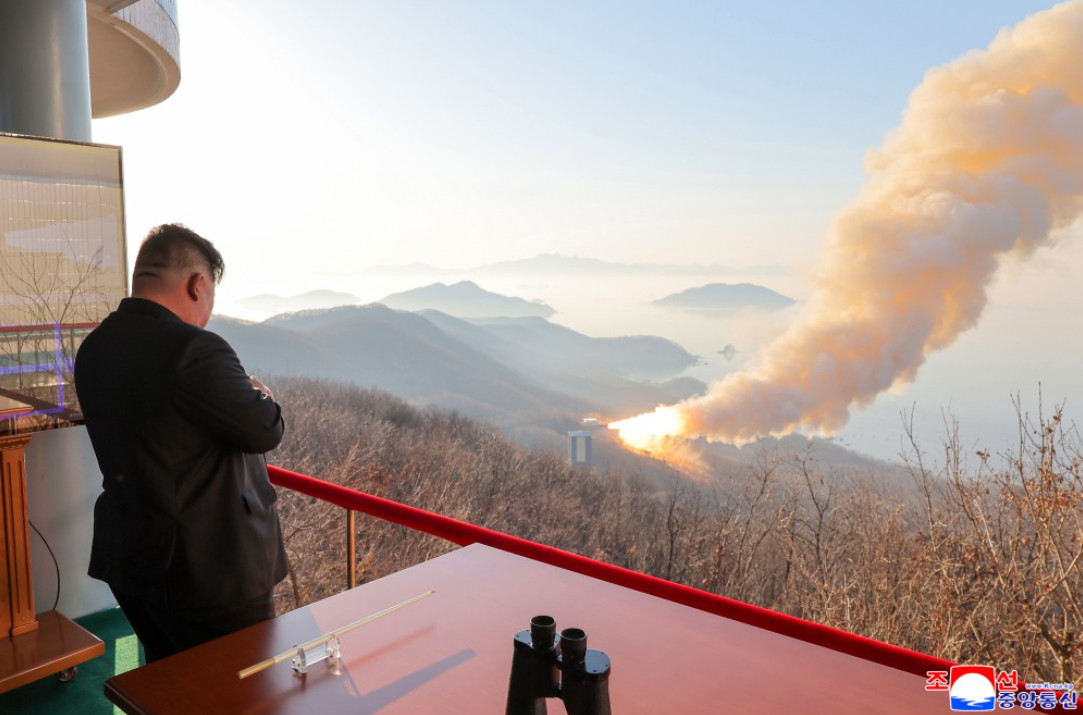
Kim Jong‑un observes the recent ground test of a solid‑fuel engine at an unidentified location. (Image: KCNA)
North Korean leader Kim Jong‑un observed a ground test of a high‑power solid‑fuel engine, the state-run Korean Central News Agency (KCNA) reported on March 29.
Analysts in South Korea say the engine is for likely use with the Hwasong‑20 solid‑fuel ICBM which is currently under development.
In its report, KCNA framed the test as a core achievement of Kim’s new five‑year defense development plan and claimed it marked a major step forward in modernizing its strategic forces.
“(The test) has truly enormous significance in raising the nation’s strategic military power to the strongest level,” Kim was quoted as saying.
The engine’s performance “fully satisfies the national strategy and military requirements for the modernization of the strategic forces,” he said.
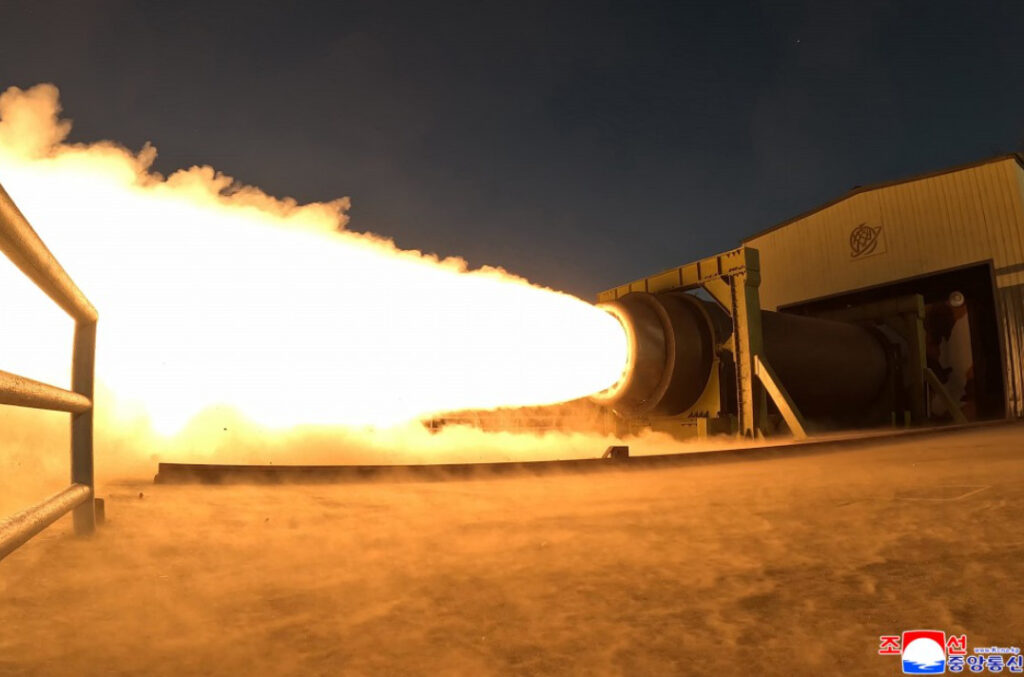
The engine being tested is composed of carbon‑fiber composite materials and rated at 2,500 kilonewtons (kN) of thrust, according to KCNA. If true, the thrust is about 26% higher than the roughly 1,971 kN claimed for a similar test last September.
Analysts believe this improved engine is likely intended for the Hwasong‑20 solid‑fuel ICBM.
Solid‑fuel, as opposed to liquid-fuel, engines eliminate the need for fueling before launch, drastically reducing preparation time and improving the ability to launch with little warning.
Carbon‑fiber composites, in particular, allow weight reduction while maintaining structural strength, improving propulsion efficiency and enabling greater payload capacity at the same thrust level.
These characteristics are directly linked to the development of MIRV (multiple independently targetable reentry vehicle) systems. Experts note that since North Korea has already secured, to some degree, ICBM ranges capable of reaching the U.S. mainland, further increases in engine output are likely aimed not at extending range but at expanding payload capacity.
“Weight reduction and enhanced durability are measures taken with MIRV deployment in mind,” said Hong Min, a senior researcher at the governmental Korea Institute for National Unification in Seoul. If MIRV technology is completed, a single missile could strike multiple targets simultaneously or overwhelm missile defense systems more effectively.
Other media and experts view the test as a signal that North Korea is strengthening the operational capability of its solid‑fuel ICBMs, although they remain cautious about the progress claimed.
Reuters reported that some experts believe the KCNA claims “may be exaggerated in the absence of verifiable evidence.”
Their skepticism rests on three main points. First, North Korea has not fully demonstrated reentry‑vehicle technology, a core requirement for ICBMs. High‑thrust engines alone cannot complete a practical nuclear force. The warhead must survive the extreme heat and pressure of atmospheric reentry.
Second, the test conditions and data were not disclosed, making external verification impossible.
Third, North Korea has a history of overstating weapons performance. In April 2024, South Korea’s Joint Chiefs of Staff assessed that Pyongyang’s announcement of a hypersonic missile test had been exaggerated.
Beyond its technical implications, the test carries a clear strategic message. Toward the United States, North Korea appears intent on continually advancing its ICBM capabilities to gain leverage in future negotiations and to cement its status as a nuclear‑armed state. It also seems to be exploiting the fact that U.S. strategic attention is divided by conflicts in the Middle East and elsewhere, seeking to increase its visibility.
Toward South Korea, the mobility and rapid‑launch capability of solid‑fuel ICBMs place additional strain on missile defense systems. While KAMD and THAAD offer some defensive capacity, the combination of MIRVs and surprise‑launch capability could significantly raise the difficulty of interception.
The regional security impact is also considerable. North Korea’s strategic‑weapon upgrades are likely to accelerate defense‑buildup debates in South Korea and Japan and could lead to deeper missile‑defense cooperation with the United States. This dynamic risks further intensifying the arms race and security dilemma in Northeast Asia.
Overall, North Korea’s test of a 2,500 kN solid‑fuel engine suggests a degree of technical progress, but its actual military significance remains difficult to assess at this stage. The true capability will become clearer only when flight tests of the Hwasong‑20 and data on reentry performance are released.
Given North Korea’s recent military activities, the possibility that this engine test will lead to a full ICBM launch is substantial. It remains uncertain what strategic weapon system North Korea will unveil or test next, but its choice could sharply alter the security landscape in Northeast Asia.

Taesung offers a unique perspective on North Korean society, drawing from years of direct experience within a key state-run institution. After resettling in South Korea in 2024, he transitioned into academia and is currently pursuing an advanced degree.
Latest posts by Kim Taesung (see all)
- Carbon‑fiber solid‑fuel engine test marks new phase in North Korea’s ICBM advancement - March 30, 2026
- The horizon I had to cross, the life I had to endure - March 10, 2026
- North Korea extends strategic nuclearization to its navy - March 7, 2026